

User Guide & Data Access
User Guide
A user guide to facilitate navigation in EarBase is available here. Follow this link to download the PDF file. Updates will be made periodically.
Download User GuideData Access
Access to EarBase content is divided into two tiers: Open and Controlled. Open Access permits unregistered visitors to browse the EarBase landing page and the FaceBase platform. Registered Open Access users have limited access to content on the EarBase platform about its Projects, Datasets and Cases (examples below). Approval for Controlled Access requires application to and approval by the Data Access Committee. This is necessary for compliance with privacy laws and NIH guidelines.
Review the procedures listed under the Data Access Policies page (also available under the POLICIES menu item on the navbar above) for detailed background and instructions.
Download Step-by-Step DAC GuideContent Availability: Overview
By default, first-time visitors to EarBase (and all FaceBase consortia) are viewing content at the Unregistered Open Access level. For EarBase, access is restricted to the landing pages. Visitors may sign up for Registered Open Access (rapid review and approval), allowing users to search and browse selected content about Cases and Specimens using keywords. Downloads are not permitted. The content available to Registered Open Access users should be sufficient to determine whether requesting Controlled Access privileges will facilitate their research goals.
Users approved for Controlled Access can access full details about Cases and Specimens, view and download full resolution images, and download approved content.
Registered Open Access
(Sign up for a log-in)
- EarBase landing pages
- FaceBase platform pages
- Browse and search selected content for all Cases and Specimens
- View sample image thumbnails
- Downloads not permitted
Controlled Access
Requires DAC approval
- Full access to EarBase content
- Browse and search all Cases and Specimens
- Otology and audiology
- Diagnostics, treatments
- Histopathology, analyses
- Full resolution images
- Data and image downloads
Examples of Open and Controlled Content
The following examples are drawn from a single Case to illustrate the difference between access levels.
Registered Open Access Level (examples)
Otologic diagnoses (summary)
- Mastoidectomy, modified radical, left.
- Fibrocystic sclerosis, peripheral cells of the mastoid.
- Ulceration, walls of the mastoid bowl.
- Atrophy, organ of Corti, left.
- Normal appearing facial nerve.
- Stria vascularis, atrophy, mild, right.
Histopathology
- Resorption of the head of the malleus and part of the manubrium. The body of the incus is intact but part of the long process is resorbed. The stapes is intact and in its normal position. The tympanic membrane is greatly thickened.
- In the basal 10 mm of the cochlea, the organ of Corti is missing. Elsewhere it is present but contains only a few scattered hair cells, possibly only 10 to 20% remaining.
- The stria vascularis is severely atrophied throughout the basal and middle turns.
- The macula sacculi appears to have a flattened sensory epithelium and some loss of hair cells. The cristae and the utricular macula appear to contain hair cells but possibly some are missing.
- Only 10 to 20% of the cochlear neurons in the basal turn, about 70% in the middle turn, and about 90% in the apical turn.
Specimen info
Listings of tissues acquired, assays conducted, example image thumbnail.
Controlled Access Level (examples of additional content available)
Full otologic history
The patient had a left mastoidectomy performed in childhood and suffered a profound hearing loss and a total left facial paralysis. It is not known whether these functional losses were caused by the infection or by the surgery. At the age of 77 he complained of pain and swelling behind the left ear. An audiogram revealed a profound hearing loss in the left ear and mild sensorineural hearing loss characterized by a flat audiometric pattern in the right ear. Speech discrimination was 88% on the right and zero on the left. Caloric tests were not performed. An operative procedure was performed to drain an abscess of the mastoid area and to enlarge the external auditory meatus. This resulted in a dry asymptomatic ear. Examination of the mastoid area at the time of this surgery revealed the frayed ends of the facial nerve in its descending portion and was interpreted to be the result of previous surgical injury. The middle ear area appeared uninfected.
Full resolution images
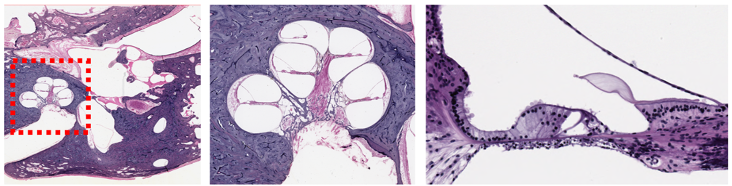
High-resolution scans available for download as approved.
Downloads
Diagnostics, summaries, images, and analyses as designated during the approval process.
Prior to their release, patient (Case) records were scrubbed to remove Protected Health Information (PHI) and Personally Identifiable Information (PII), following HIPAA and NIH guidelines (Requirements for NIH Controlled-Access Data Repositories and Users). Also redacted or revised were instances of inappropriate and outdated terms. Please contact us if you discover questionable content in EarBase.